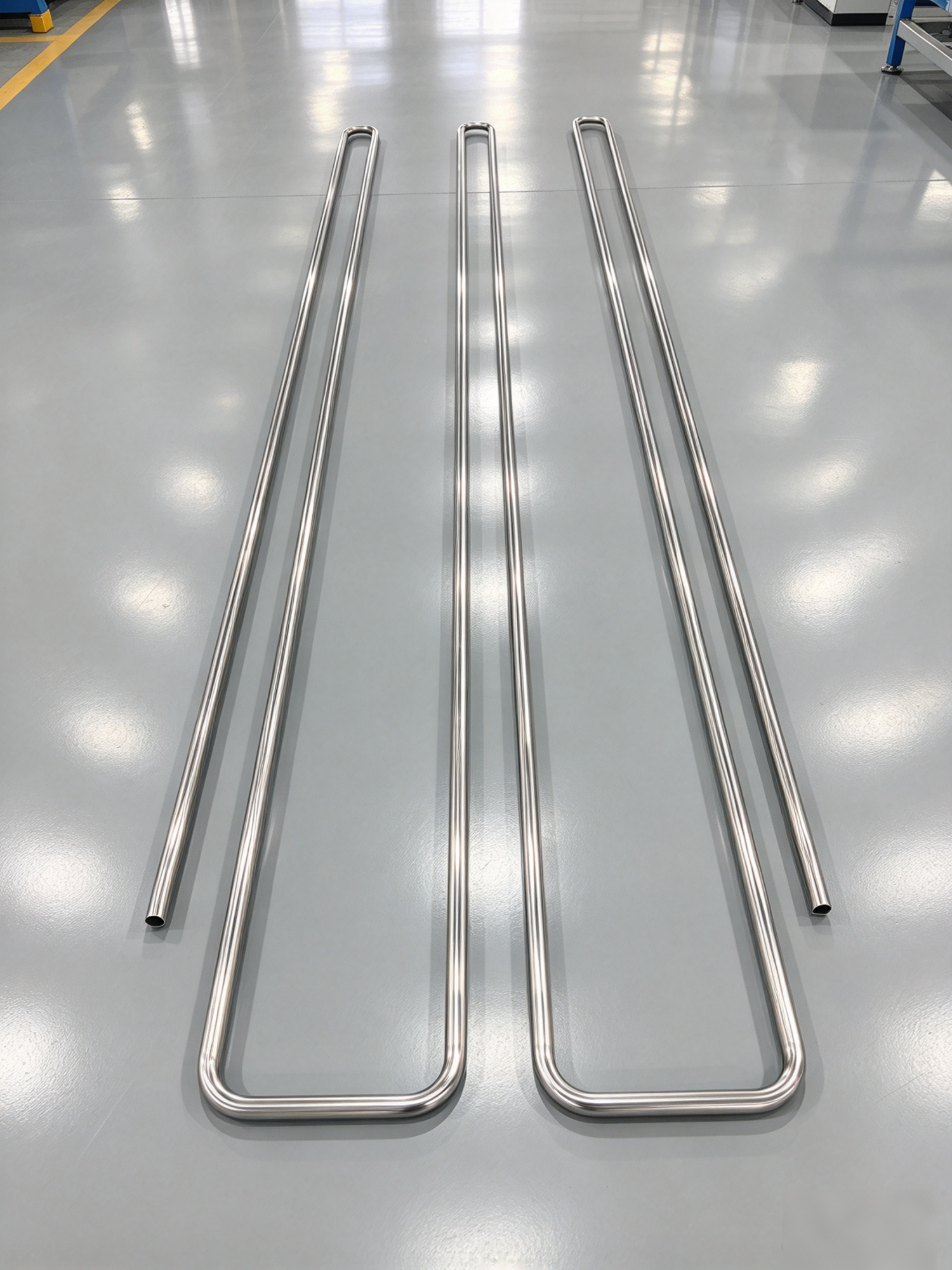

Straight tubes are bent in multiple segments into a serpentine back-and-forth layout, with a compact flow path and large heat-transfer area per unit space. Bend pitch, radius and layer spacing are customized to the heat-exchanger core layout, and tubes can be assembled with headers into bundles for boilers, waste-heat recovery and new-energy heat-exchange equipment.
| Tube OD | φ8–32mm (reference) | Wall thickness | 0.5–3mm (reference) |
| Available materials | 304, 304L, 321, 316L, 310S; duplex 2205, 2507, S32101 | Total length | Custom |
| Bending parameters | Pitch, bend radius and layer spacing per drawing | Surface finish | Pickled (optional) |
| Inspection | Eddy current test, hydrostatic test (as required) | Customization | Developed from drawings/samples; assembled with headers into bundles |
| Typical applications | Heat-exchanger cores, boilers, waste-heat recovery, new-energy heat-exchange equipment | ||
Q: How to choose between a serpentine tube and a spiral coil?
A: Serpentine tubes suit elongated boxes, box-type equipment and planar back-and-forth layouts; spiral coils suit circular winding inside cylindrical vessels. Selection follows the equipment structure and available space.
Q: Can pitch, bend radius and layer spacing be customized to our core drawing?
A: Yes. Pitch, bend radius and layer spacing are customized to the core layout drawing, and tubes can be assembled with headers into bundles; total length is set on request.
Q: Which material suits high-temperature or corrosive service?
A: Common heat-exchange use: 304, 304L, 321, 316L; high-temperature service: 310S; corrosive chloride or acid-alkali service: 2205, 2507, S32101 duplex. The grade is selected by medium and temperature.
CONTACT US